Best Ecommerce Website Builders for 2026 and 2027, Compared
Shopify, Photon Stores, Amboras, v0, Lovable, BigCommerce, WooCommerce, Wix and Squarespace compared on real prices, fees, AI and fit. Checked November 2026.
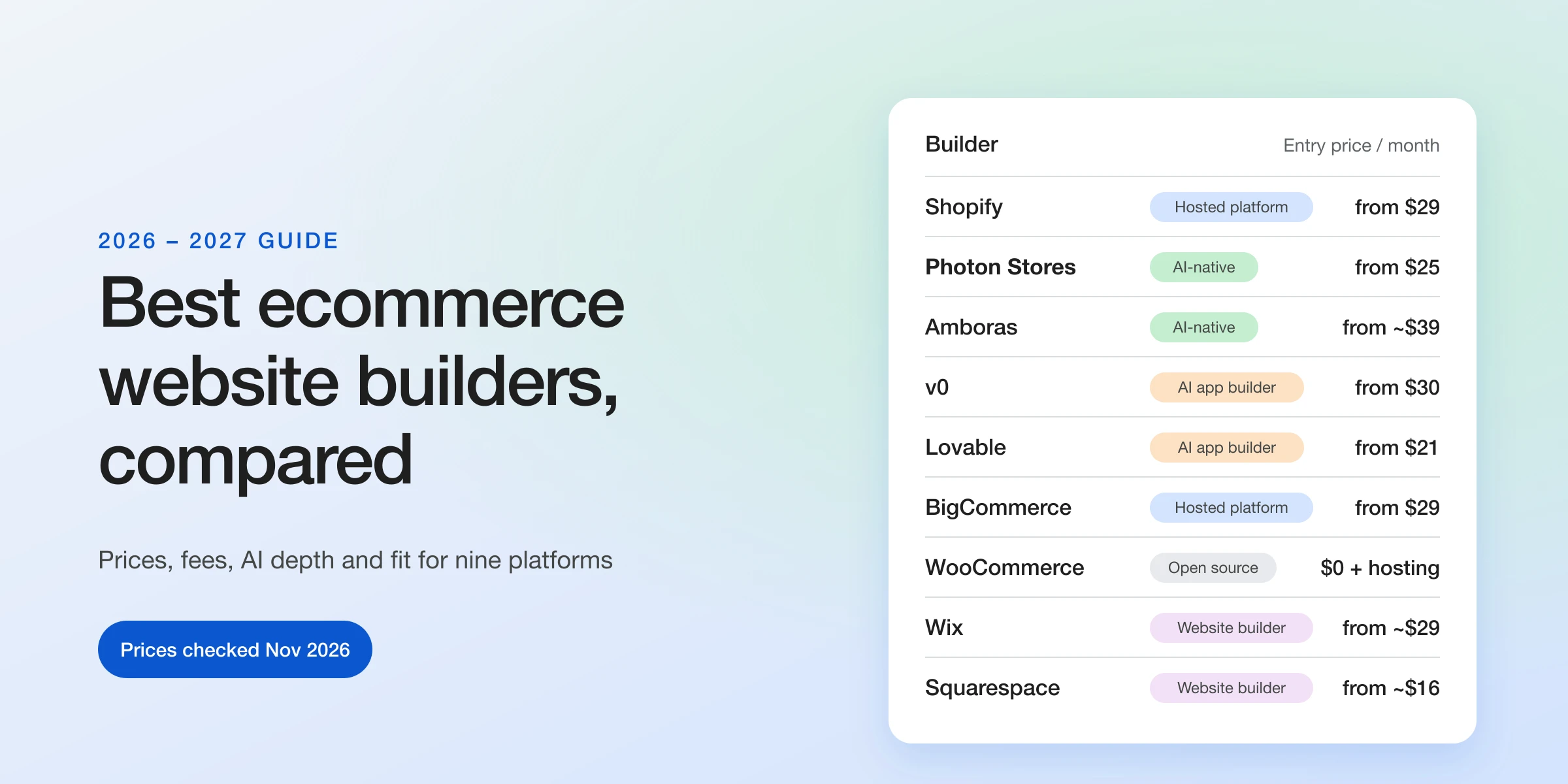
For most independent brands launching or relaunching a store in 2026, the best ecommerce website builder is one that does the work, not one that hands you a theme. AI-native platforms such as Photon Stores now design, write, photograph and help run a store from a description, which removes the biggest hidden cost of selling online: your own hours. Shopify remains the strongest choice for brands that already depend on its app ecosystem or sell across many countries and channels. AI app builders like v0 and Lovable can generate a custom storefront in an afternoon, but leave commerce to something else.
This guide compares nine builders on what each plan costs, what you pay per order, what the AI actually does, how hard it is to leave, and who each one suits. Every price was checked on the vendor's own page or a dated, named source on 3 November 2026. Where sources disagreed, we say so instead of picking the flattering number.
Disclosure: Photon Stores publishes this guide, and we build one of the platforms in it. We have tried to write the comparison we would want to read if we were choosing. Where Photon Stores is weaker, for example in app ecosystem, payment providers outside India, and maturity, we say so plainly.
Keshav Sharma, co-founder, Photon Stores
The short answer: the best ecommerce builder for each kind of seller
- Best for independent brands that want a finished store and less busywork: Photon Stores. A designed store, a product photoshoot, checkout with cash on delivery and tax invoices in about two minutes, then AI agents for SEO, operations, support and QA. From $25 a month, with a free start.
- Best for brands scaling across many channels and countries: Shopify. Best-known checkout, broadest payments, deepest app and agency ecosystem. You assemble design, content and photography yourself or with apps.
- Best AI-native platform for conversion testing: Amboras. Stripe and PayPal checkout, plus generative A/B testing. From about $49 a month.
- Best for a fully custom, code-owned storefront: v0 by Vercel. You get real Next.js code you own, but you build the commerce backend yourself or connect Shopify.
- Best for prompting a storefront on top of Shopify: Lovable. Chat builds the front end; Shopify runs checkout and orders.
- Best for large catalogs and B2B: BigCommerce. No extra fee on its embedded payment providers, strong catalog and API depth.
- Best for full control and lowest software cost: WooCommerce. Free and open source, but you own hosting, security and updates.
- Best for a small shop inside a broader website: Wix. Strong editor, many site features, adequate commerce.
- Best for design-led small catalogs and creatives: Squarespace. Beautiful templates, 0% store fee from the Core plan.
At a glance: nine ecommerce builders compared
| Builder | Type | Entry price (USD / month) | Extra fee on outside payment providers | AI builds the store? | Best for |
|---|---|---|---|---|---|
| Photon Stores | AI-native platform | $25 (Starter), free start with 100 credits | None listed on pricing page | Yes, design, copy and photos, then AI agents run it | Independent brands that want the work done |
| Shopify | Hosted platform | $29 yearly, $39 monthly (Basic) | 2% Basic, 1% Grow, 0.6% Advanced | Partly (Sidekick, AI tools) | Brands scaling across channels |
| Amboras | AI-native platform | About $49 monthly, about $39 yearly (Basic) | Not published | Yes, design, copy, image enhancing | Brands focused on conversion testing |
| v0 (Vercel) | AI app builder | Free tier; paid from $30 per user | Not applicable, you wire up Stripe | Generates code, not a store | Teams with a developer |
| Lovable | AI app builder | $25 (Pro), plus a Shopify plan | Shopify's fees apply | Generates the storefront on Shopify | Prompted storefronts on Shopify |
| BigCommerce | Hosted platform | $29 yearly, $39 monthly (Core) | 2% Core, 1% Growth, 0.6% Scale | Limited | Large catalogs, B2B |
| WooCommerce | Open-source plugin | $0 software, plus hosting | None | No (plugins only) | Full control on WordPress |
| Wix | Website builder | About $29 yearly (Core) | None stated | Yes, AI site builder | Small shop inside a broader site |
| Squarespace | Website builder | About $16 to $19 yearly (Basic) | 2% on Basic, 0% from Core | Partly | Design-led small catalogs |
How we compared them
Most “best ecommerce platform” lists rank by feature count. That rewards platforms with the longest marketing page. We used seven criteria that decide whether a store actually makes money, and we weighted cost by what a small business really pays, including its own time, not just the sticker price.
- Total cost of ownership: plan price, the platform's own transaction fees, card processing, and what you will likely add in apps, hosting or developer time.
- Time to a sellable store: how long from sign-up to a store with real products, real photos, a working checkout and policies a shopper will trust.
- AI depth: whether the AI actually does the work (builds pages, photographs products, tests changes, answers support) or only suggests text in a sidebar.
- Work done for you: how much of the design, photography, copy, SEO, testing and support you would otherwise do yourself, or pay apps, freelancers and agencies to do.
- Payments and checkout: which payment methods shoppers can use, where the platform works, and whether checkout is proven at scale.
- Ecosystem and scale: apps, integrations, agencies and documented large merchants. This is where young platforms are weakest.
- Ownership and portability: whether you can export your data and code, and how hard it is to leave.
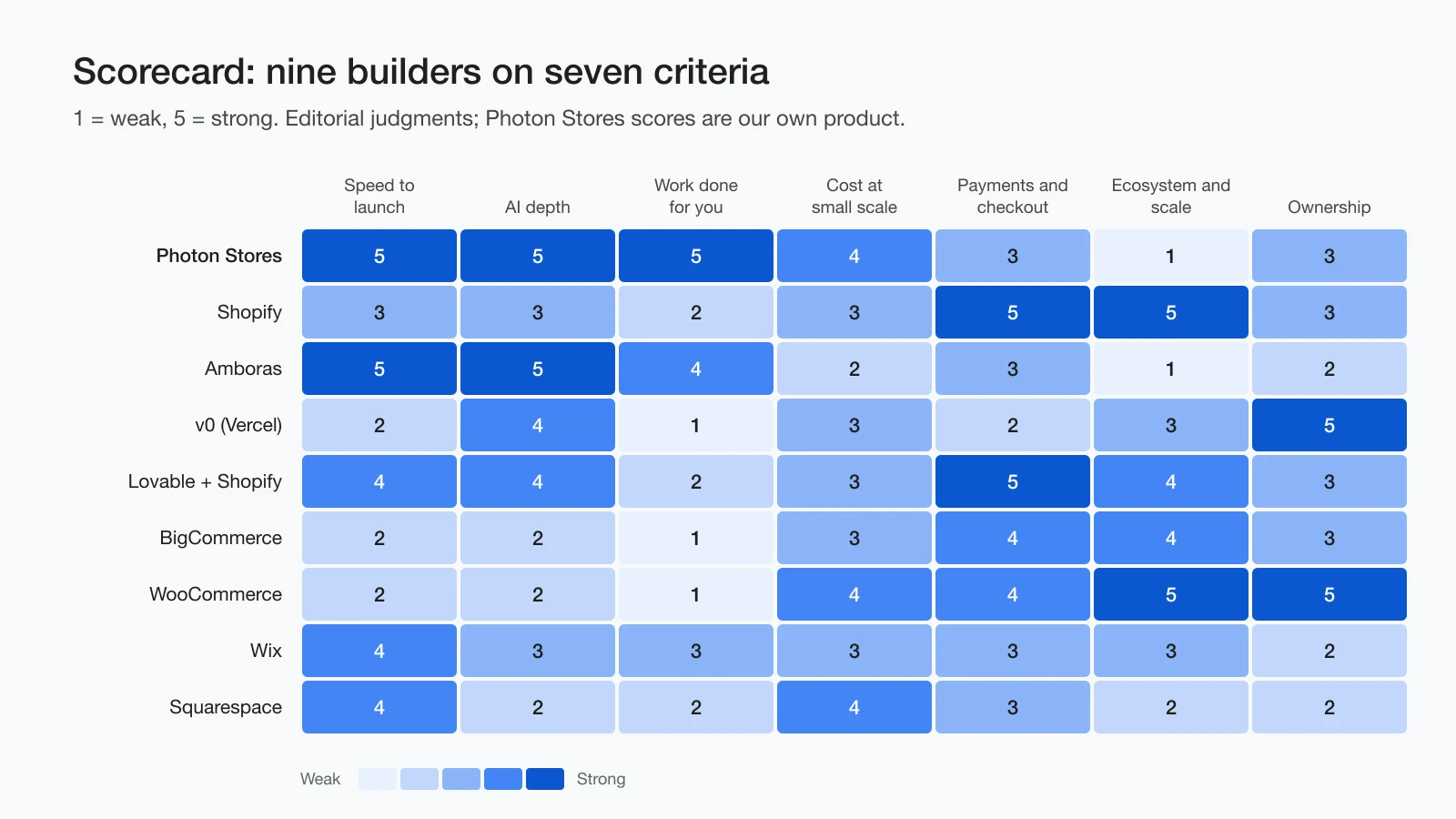
We scored each criterion from 1 to 5. These are judgments, not lab measurements, and you should weigh them by what matters to your business. A brand doing $5 million a year with an in-house team will weigh ecosystem heavily. A founder launching or growing an independent brand should weigh speed, cost and work done for them most, because those decide whether the store gets built well and kept up.
| Builder | Speed to launch | AI depth | Work done for you | Cost at small scale | Payments and checkout | Ecosystem and scale | Ownership |
|---|---|---|---|---|---|---|---|
| Photon Stores | 5 | 5 | 5 | 4 | 3 | 1 | 3 |
| Shopify | 3 | 3 | 2 | 3 | 5 | 5 | 3 |
| Amboras | 5 | 5 | 4 | 2 | 3 | 1 | 2 |
| v0 (Vercel) | 2 | 4 | 1 | 3 | 2 | 3 | 5 |
| Lovable + Shopify | 4 | 4 | 2 | 3 | 5 | 4 | 3 |
| BigCommerce | 2 | 2 | 1 | 3 | 4 | 4 | 3 |
| WooCommerce | 2 | 2 | 1 | 4 | 4 | 5 | 5 |
| Wix | 4 | 3 | 3 | 3 | 3 | 3 | 2 |
| Squarespace | 4 | 2 | 2 | 4 | 3 | 2 | 2 |
Four kinds of ecommerce builder in 2026
Before comparing brands, it helps to see that these nine tools are not the same kind of product. Comparing v0 with Shopify is like comparing a lathe with a furniture shop. Both can get you a table, but one assumes you are a carpenter.
1. Hosted commerce platforms: Shopify and BigCommerce
You rent a complete commerce engine: catalog, checkout, payments, orders, tax, shipping. You pick a theme and extend it with apps. These platforms are proven at very large scale. The trade-off is that you do the design, copy, photography and ongoing optimisation yourself, or pay apps and agencies to do it.
2. Website builders with a store: Wix and Squarespace
Strong visual editors with commerce added. They suit service businesses, creators and small catalogs where the website matters as much as the shop. They are less suited to high-volume operations, complex catalogs or international expansion.
3. Open source: WooCommerce
Free software on WordPress. You own everything, and you are responsible for everything: hosting, security, updates, backups and plugin conflicts. It is the cheapest option in licence fees and often the most expensive in time.
4. AI-native commerce platforms: Photon Stores and Amboras
The newest category. You describe the business and the platform builds a finished store: layout, copy, images and a working checkout. Then AI continues to operate parts of it, such as testing variations, writing SEO content, drafting support replies or checking the store for broken flows. These platforms are young. They trade ecosystem maturity for speed and less manual work.
And a fifth: AI app builders, v0 and Lovable
v0 and Lovable are not ecommerce platforms. They generate application code from a prompt. They can produce a gorgeous storefront, but commerce, meaning inventory, orders, tax, refunds and fraud, has to come from somewhere else: Stripe, Shopify, or code you write. They belong in this comparison because many founders now try them first. Knowing what they do not include will save you weeks.
Photon Stores: an AI-native store that is built and run for you
Photon Stores is our product, so we would rather you judge it by trying it than by our description. It is built for independent brands that want a finished, well-designed store without assembling a theme, an app stack and a photographer, and without spending every Sunday night keeping it up.
You describe the business or paste the address of a site whose look you like. Before anything is built, you see the top of your store in three different live designs, with your own words in them. You pick one. About two minutes later, there is a store you can click through: pages, sample products, copy in your voice, and a product photoshoot with products on their own, in use, and worn or held by people. Photographs keep arriving for a few minutes after that. You change anything by asking in plain language, and every change is a version you can roll back.
Photon Stores pricing
| Plan | Price | AI credits | Notable inclusions |
|---|---|---|---|
| Free start | $0, no card | 100 credits | Enough for a text-only store |
| Starter | $25 / month | 500 a month | Three looks, photoshoot, checkout with cards, wallets and cash on delivery, tax invoices, edit by asking, own domain |
| Growth | $79 / month | 2,000 a month | Everything in Starter plus the full AI team (SEO, operations, support), team roles, gift cards, migration from Shopify or WooCommerce, priority human help |
Where Photon Stores is strong
- Time to a finished store: design, copy and photography are produced together rather than assembled from a theme and apps.
- Photography included: a generated product photoshoot that you can replace frame by frame with your own pictures.
- Built for Indian checkout: cards, wallets, bank transfers and cash on delivery by default, tax invoices on every order, and WhatsApp order updates.
- An AI team, not a chatbot: agents for web, content, SEO, photos, operations, support, social and QA. A QA agent opens the store on desktop and phone and walks the checkout. Nothing that costs money or changes a price goes live without your approval.
- Search-ready pages: titles, descriptions, structured data, a sitemap and an llms.txt file for AI assistants ship with every store.
- Isolation: every store has its own database. Card details go straight to the payment provider.
What replaces the app stack
The jobs most stores pay separate apps for are built in: reviews with photos and search, order and marketing emails, WhatsApp updates, cookie-free analytics, A/B testing of heroes, copy and offers, discount codes and gift cards, variants and stock by location, shipping rates and labels, self-service returns, and store pickup or local delivery. That is why the plan price is closer to the real price than on platforms where it is only the starting point.
What to know before you choose it
- It is new, and stores are being onboarded from a waitlist. It does not yet have the long public track record of a platform like Shopify.
- There is no third-party app store. Most common app jobs are built in, but if you rely on a niche Shopify app, check that its job is covered.
- Payments are strongest for India today: cards, wallets, bank transfers and cash on delivery. More providers and currencies are coming; brands selling mainly in the US or Europe should check coverage first.
- AI work is metered in credits. Every action shows its cost before it runs, and unused credits roll over for two months.
Verdict: For an independent brand, Photon Stores gets you furthest for the least time and money: a finished, photographed store with checkout ready on day one, and agents that keep doing the repetitive work while you approve what ships. It is the platform we would choose for a new or rebuilding brand, especially one selling in India. If you need a large app ecosystem or broad international payments today, Shopify is the safer pick.
Related guide: Running a complete store on Photon Stores
Shopify: the default for a reason
Shopify processed $378.4 billion of gross merchandise volume in 2025, up 29% from $292.3 billion in 2024, according to its annual report. It estimates that its merchants account for more than 14% of US ecommerce. No other builder in this list comes close on scale, and scale buys things that matter: a checkout millions of shoppers already trust, fraud tooling trained on huge volumes, and thousands of apps and agencies.
Shopify pricing in 2026
| Plan | Billed yearly | Billed monthly | Online card rate (Shopify Payments, US) | Fee if you use another provider |
|---|---|---|---|---|
| Basic | $29 | $39 | 2.9% + 30¢ | 2% |
| Grow | $79 | $105 | 2.7% + 30¢ | 1% |
| Advanced | $299 | $399 | 2.5% + 30¢ | 0.6% |
| Plus | From $2,300 (3-year term) | Contact sales | Negotiated | 0.2% |
Shopify currently offers a three-day free trial, followed by a low introductory price for the first three months. In India, the same plans are priced in rupees. Basic is ₹1,499 a month billed yearly or ₹1,994 monthly. Shopify Payments is not available in India, so Indian merchants use a gateway such as Razorpay and pay Shopify's third-party transaction fee on top of the gateway fee. On Basic, that is Shopify's 2% plus Razorpay's standard 2% plus GST on the gateway fee. Razorpay's own worked example puts the total at about 4.4% of a ₹1,000 order. Cash on delivery orders do not attract Shopify's third-party fee.
Where Shopify is strong
- Checkout: Shop Pay and Shopify's checkout are among the most tested in the industry.
- Ecosystem: estimates of the App Store's size range from roughly 12,000 to more than 25,000 apps depending on how they are counted, and there is a large agency and freelancer market.
- Scale: from a single product to Shopify Plus enterprises, without replatforming.
- Channels: point of sale, marketplaces, social and, increasingly, AI shopping agents. Shopify's Fall '26 Edition, released in late October 2026, centred on agentic commerce, where AI assistants discover and buy products for shoppers.
Where Shopify is weaker
- You build the store yourself. Themes are a starting point. Copy, photography, SEO content and testing are your job or an app's.
- App costs add up. Reviews, email, subscriptions, page builders and SEO tools are often separate subscriptions. Third-party trackers estimate a typical store runs several apps, though published averages vary widely.
- AI is an assistant, not an operator. Sidekick can answer questions, generate reports and help with tasks in the admin, but you still direct most of the work.
- Fees outside Shopify Payments, which matters in India and other countries where Shopify Payments is unavailable.
Verdict: Choose Shopify if you expect to grow beyond a small catalog, sell across many channels, or need a specific app that only exists in its ecosystem. Budget for apps and for your own time, or an agency's.
Amboras: AI-native commerce focused on conversion
Amboras is a Y Combinator-backed platform that describes itself as an AI-native ecommerce platform. Its founders, brothers Amin and Imad Mokadem, previously built EcomCoder, a Shopify developer tool, and ran an educational board game brand. Like Photon Stores, Amboras builds the storefront from a prompt and lets you edit layout and sections by asking. Its distinctive focus is generative A/B testing: the system generates store variations, such as offers, layouts and copy, tests them, and lets you ship the winner with one click.
Amboras pricing
Amboras's pricing page shows prices in Indian rupees for visitors from India and says it bills in US dollars at checkout. Basic is ₹4,651 a month, or ₹3,701 a month billed yearly. That matches the roughly $49 a month starting price reported by third-party comparisons, and about $39 a month billed yearly. At the same exchange rate, Pro is about $105 a month and Advanced about $299. Plus starts at about $2,500 a month. Plans differ mainly by number of stores, seats, domains and support level. A 30-day launch guarantee covers Basic, Pro and Advanced. The pricing page does not publish a platform transaction fee.
Where Amboras is strong
- Generative A/B testing built into the platform, rather than bolted on as an app.
- Stripe and PayPal from day one, plus Apple Pay, Google Pay and one-click checkout. That suits US and European brands.
- First-party analytics that track sessions, funnels and revenue without third-party pixels.
- A broad module list: AI image enhancement, AI SEO, reviews, AI emails, bundles, upsells and subscriptions.
Where Amboras is weaker
- It is young, and public proof is thin. Its headline claim of over 80% conversion lift on the first live version comes from beta merchants, with no published sample size or method. Treat it as a vendor claim until independent results appear.
- Entry price is higher than Shopify Basic or Photon Stores Starter.
- Checkout, analytics and hosting are platform-run. Review the export and portability terms before committing.
- Like any new platform, the integration and agency ecosystem is small.
Verdict: Amboras is worth a serious look if you already have traffic and want a platform that keeps testing and improving conversion for you. If you are pre-revenue, the testing engine has little traffic to learn from, and a cheaper start may make more sense.
v0 by Vercel: a custom storefront you own, but not a store platform
v0 is Vercel's AI app builder. You describe an interface and it generates React and Next.js code, which you can deploy on Vercel and edit like any codebase. For a storefront, that means near-total design freedom and code you own outright. It also means v0, on its own, has no product catalog, orders, inventory, tax, refunds or fraud protection.
There are two common ways to turn a v0 project into a real store. The first is to connect Stripe, which became generally available on the Vercel Marketplace and in v0 in March 2026, and build a simple checkout with Stripe Checkout sessions. The second is to use Shopify as a headless backend through its Storefront API, as in Vercel's Next.js Commerce template, which Vercel now maintains for Shopify.
v0 pricing
v0 has a free tier limited to seven messages a day. Paid plans start at $30 per user per month with $30 of monthly credits, and Business is $100 per user per month. Hosting on Vercel and Stripe's processing fees, 2.9% plus 30¢ per successful US card charge on standard pricing, are separate.
- Strong: design freedom, code ownership, modern performance, and no platform lock-in on the storefront.
- Weak: you, or a developer, are now responsible for checkout security, tax, order emails, inventory and returns. These are exactly the things a commerce platform exists to handle.
- Best for: teams with a developer who want a distinctive headless storefront, usually in front of Shopify.
Verdict: v0 is an excellent front-end tool and a poor choice as your only ecommerce platform. If you are not comfortable owning a codebase, start elsewhere.
Lovable: prompt a storefront, let Shopify run commerce
Lovable is another AI app builder, and in October 2025 it launched a Shopify integration. You describe the store in chat, Lovable builds the storefront, and you claim and publish it as a Shopify store. That pairs Lovable's design speed with Shopify's checkout and order management. At launch, the integration worked only for new Shopify stores and came with an extended Shopify trial for people who signed up through Lovable.
Lovable's Pro plan is $25 a month, or about $21 billed yearly, with 100 monthly credits plus daily build credits. You still pay for your Shopify plan and Shopify's payment fees. Independent coverage noted that, at launch, the integration did not natively support advanced Shopify features such as metafields or Liquid customisations.
Verdict: Lovable is a good way to get a distinctive custom storefront on Shopify without a developer. Expect to bring in a developer once you need deeper Shopify features.
BigCommerce: catalog depth and no extra fee on embedded payments
BigCommerce restructured its plans into Core, Growth, Scale and Performance. The first three mirror Shopify's prices: $29, $79 and $299 a month billed yearly, or $39, $105 and $399 monthly. Two differences matter. First, each plan has an online sales threshold based on trailing twelve-month sales: up to $30,000 on Core and $100,000 on Growth, while Scale is capped at $33,333 a month and charges 0.9% on sales above it. Second, orders through BigCommerce's embedded payment providers carry no extra fee, while other open payment providers incur 2%, 1% or 0.6% depending on the plan. Card processing starts at 2.89% plus 29¢. Performance, the enterprise tier, starts at $1,499 a month.
- Strong: large and complex catalogs, B2B features, multi-storefront, and an API-first architecture popular for headless builds.
- Weak: smaller app and theme ecosystem than Shopify, a steeper learning curve, and sales thresholds that can force a plan upgrade as you grow.
- Best for: mid-market and B2B sellers with complex catalogs.
WooCommerce: maximum control, maximum responsibility
WooCommerce is a free, open-source plugin for WordPress. Third-party trackers rank it second only to Shopify among US ecommerce platforms by number of stores. You pay nothing for the software. You do pay for hosting, a domain, a theme, premium extensions, and someone to keep WordPress, plugins and security patched. WooPayments, its own payment service, has no monthly fee and charges 2.9% plus 30¢ for US cards, plus 1.5% for international cards and 1% for currency conversion.
- Strong: you own the code and the data, can host anywhere, and can extend it with tens of thousands of WordPress plugins. Excellent for content-heavy stores.
- Weak: performance, security and updates are your responsibility. Plugin conflicts are common, and total cost often rises with developer time.
- Best for: merchants already on WordPress, or teams with a developer who want full control.
Wix: a strong website builder with a capable shop
Wix's plans that can take payments start with Core, at about $29 a month billed yearly, followed by Business at about $39 and Business Elite at about $159. Prices vary by region. Wix Payments charges 2.9% plus 30¢ per online card transaction in the US, according to multiple 2026 guides, with a higher rate reported for American Express. Wix has an AI site builder that creates a site from a conversation, and its editor is among the most flexible in this list.
- Strong: design flexibility, an all-in-one website with bookings, events and blogging, and an approachable editor.
- Weak: commerce depth and scalability trail Shopify and BigCommerce. Migrating away is harder because the site is tied to Wix's editor.
- Best for: service businesses, creators and small catalogs where the website matters as much as the store.
Squarespace: design-led, simple, and 0% store fees from Core
Squarespace's current lineup is Basic, Core, Plus and Advanced. Published 2026 US prices vary by source. One guide from September 2026 lists $16, $23, $39 and $99 a month billed yearly. Others list Basic at about $19 and Core at about $29. Fees are consistent across sources: Basic charges 2% on physical product sales, and Core and above charge 0%. Fees on digital products and memberships fall from 7% on Basic to 0% on Advanced. Card processing is charged separately.
- Strong: some of the best-looking templates available, simple to run, and good value from Core upwards.
- Weak: limited apps and integrations, less flexible catalog and checkout, and not designed for high volume or complex operations.
- Best for: photographers, designers, studios and small brands with tight catalogs.
What it really costs to run a store doing $10,000 a month
Plan prices get the attention, but at almost any real sales volume, card processing dwarfs them. To make this concrete, we modelled a store selling $10,000 a month online through 200 orders at a $50 average order value, paid with domestic cards. We used each platform's entry plan that can sell, billed yearly, and its own or recommended payment processor. Your numbers will differ. The pattern will not.
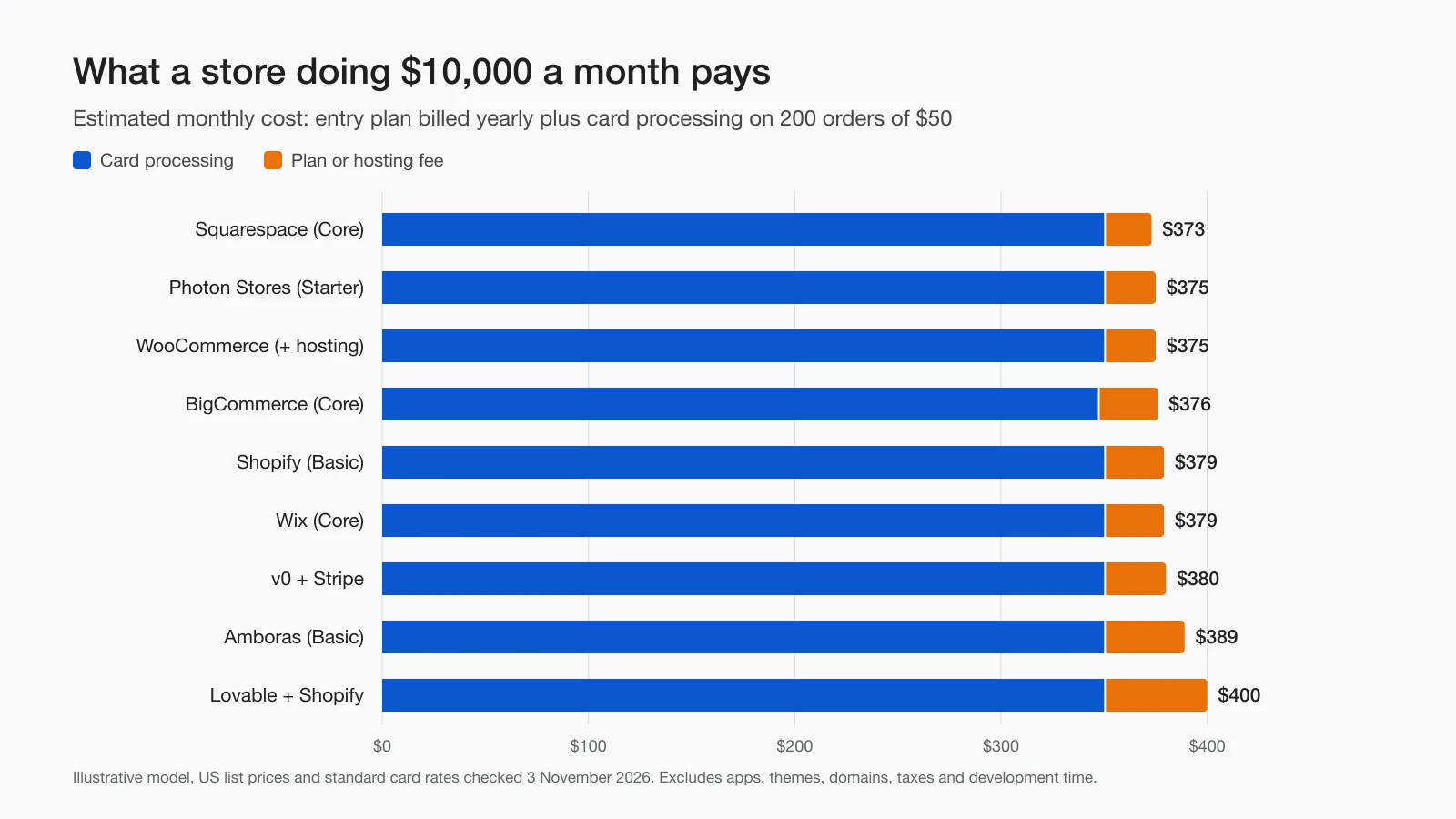
| Builder | Plan (yearly) | Card processing | Platform transaction fee | Estimated monthly total |
|---|---|---|---|---|
| Shopify | $29 | $350 (2.9% + 30¢) | $0 with Shopify Payments | About $379 |
| BigCommerce | $29 | $347 (2.89% + 29¢) | $0 with embedded providers | About $376 |
| Wix | About $29 | $350 (2.9% + 30¢) | $0 | About $379 |
| Squarespace | $23 to $29 | About $350 | $0 on Core | About $373 to $379 |
| WooCommerce | $0 + hosting (we assumed $25) | $350 (WooPayments) | $0 | About $375 plus extensions |
| Photon Stores | $25 | Provider rate (we assumed 2.9% + 30¢ for comparison) | None listed | About $375 |
| Amboras | About $39 | $350 (Stripe standard) | Not published | About $389 |
| v0 + Stripe | From $30, plus hosting | $350 (Stripe standard) | $0 | About $380 plus development time |
| Lovable + Shopify | $21 + $29 | $350 (Shopify Payments) | $0 | About $400 |
The takeaway is uncomfortable for anyone who chooses a platform on sticker price. At $10,000 a month, every option lands within about $30 of the others, and roughly 90% of the bill is card processing. The real differences are elsewhere.
- Third-party payment fees. Use a gateway other than the platform's own and Shopify Basic adds 2%, which is another $200 on this store. In India, where Shopify Payments is unavailable, this applies to every prepaid order.
- Apps and add-ons. Reviews, email marketing, SEO tools and page builders can each cost $10 to $100 or more a month on a traditional platform. AI-native platforms bundle more of this into the plan.
- Your time. A founder spending ten hours a week on product photos, copy and fixing layouts is spending the most expensive resource in the business.
- Conversion rate. This is the biggest lever of all. On 10,000 monthly sessions converting at 2%, lifting conversion to 2.2% adds 20 orders, or $1,000 a month. That is more than the difference between the cheapest and most expensive platform here, many times over.
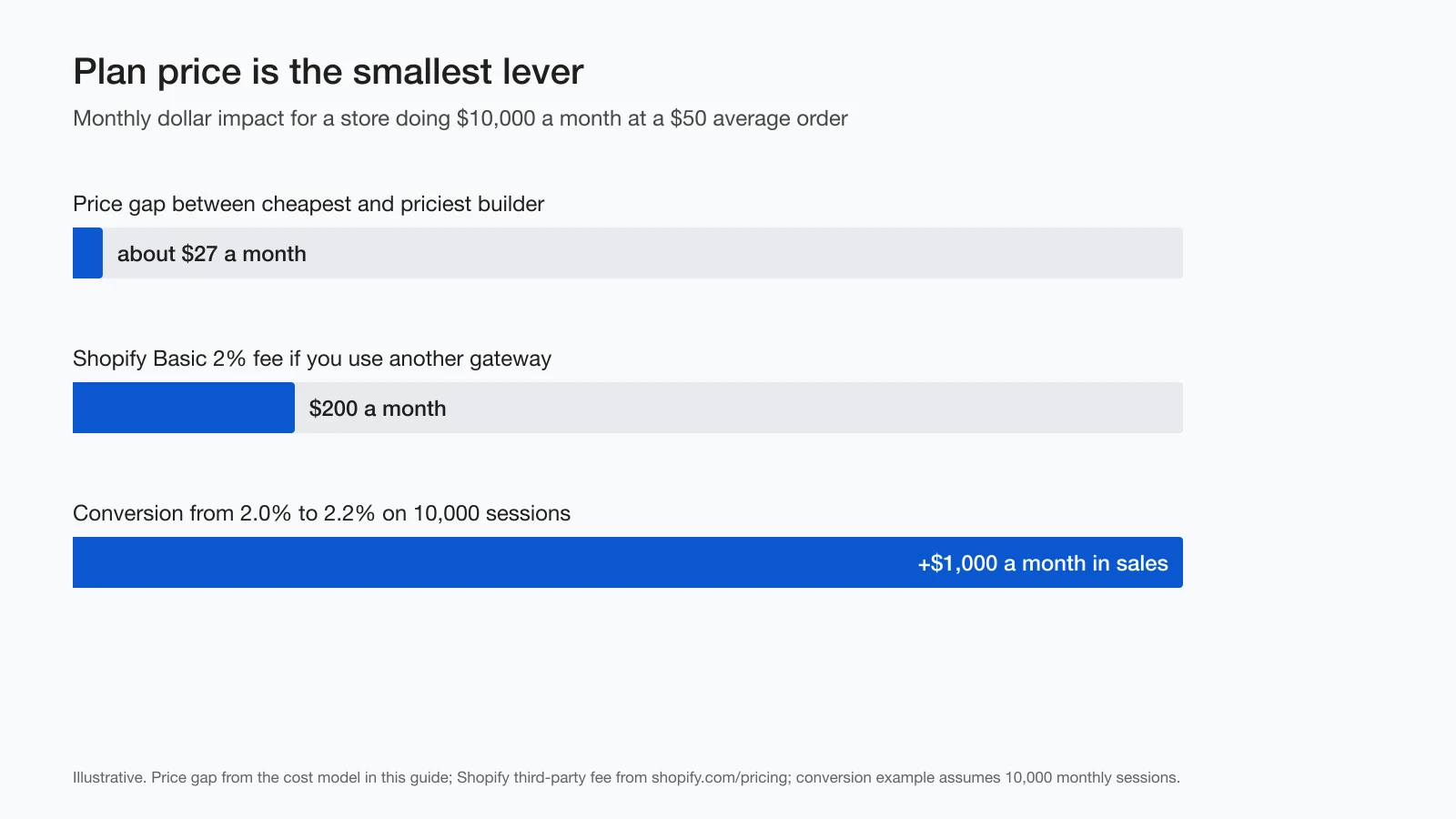
This is why we would not choose a builder on its plan price. Choose on the store it helps you ship, how well its checkout converts in your market, and how many hours it gives back. That is the gap Photon Stores was built to close: photography, copy, SEO, testing, QA and support drafting are part of the plan, so the hours and the app subscriptions do not quietly pile up on top of it.
Feature comparison: what is built in
| Feature | Shopify | Photon Stores | Amboras | v0 | BigCommerce | WooCommerce | Wix | Squarespace |
|---|---|---|---|---|---|---|---|---|
| AI generates the whole store | No | Yes | Yes | Front end only | No | No | Website, yes | Partly |
| AI product photography | Image editing | Full photoshoot | Image enhancing | No | No | Plugins | Image tools | No |
| Built-in A/B testing | Apps | Yes | Yes, generative | Code it | Apps | Plugins | Limited | No |
| Cash on delivery | Yes | Yes, default | Not listed | Code it | Yes | Yes | Yes | Limited |
| Tax invoices on every order | Apps in many regions | Yes | Automatic tax | Code it | Yes | Plugins | Yes | Limited |
| WhatsApp order updates | Apps | Yes | Not listed | Code it | Apps | Plugins | Apps | No |
| Migration from Shopify or WooCommerce | Import tools | Yes, paste a URL | Yes | Manual | Yes | Plugins | Limited | Limited |
| App ecosystem | Largest | None | Small | npm and Vercel | Large | Very large | Medium | Small |
| Code access | Liquid themes | Custom code and code editor | Not stated | Full | Themes and API | Full | Velo | Code blocks |
AI in ecommerce builders: what is real and what is marketing
Every platform now says “AI”. The useful question is what the AI is allowed to do on its own, and what it needs you for. We see four levels.
- Level 1, AI writes text: product descriptions and email subject lines in a sidebar. Nearly every platform offers this now.
- Level 2, AI assists in the admin: an assistant that answers questions, builds reports and performs tasks you request. Shopify's Sidekick is the leading example, and its 2026 Editions expanded what it can do with store data.
- Level 3, AI builds the store: design, pages, copy and images from a prompt. Photon Stores, Amboras, Wix's AI site builder and Lovable work here.
- Level 4, AI operates the store: agents that run continuous jobs, such as testing variations, fixing SEO issues, drafting support replies and checking checkout, under rules the owner sets. Photon Stores' agent team and Amboras's generative testing are early examples.
Level 4 is where the economics of running a small store change, and also where it can go wrong. An agent that changes prices or publishes unreviewed copy can do real damage. When evaluating AI-native platforms, ask what requires your approval, whether every change is versioned and reversible, and whether the agent can see real context such as orders, inventory and policies before it acts.
Related guide: What AI agents are, and how the Photon Stores team works
SEO, GEO and AEO: which builders help you get found
Search is changing in two directions at once. Classic Google search still drives a large share of ecommerce traffic. Meanwhile, shoppers increasingly ask AI assistants for recommendations, and those assistants cite pages they can understand. Generative engine optimisation (GEO) and answer engine optimisation (AEO) are new names for an old discipline: pages that clearly define what you sell and answer real questions in a structure machines can parse.
Any of these builders can rank. What differs is how much of the work is done for you. Look for these five things.
- Structured data: Product, Offer, Review, BreadcrumbList and FAQPage schema generated automatically and kept correct as products change.
- Clean, editable URLs and automatic redirects when you rename or move pages, which is essential during a migration.
- Speed on a mobile phone, because Core Web Vitals and shoppers both punish slow pages.
- Real words on collection pages, and the ability to add FAQs and guides without a separate CMS.
- AI-assistant readability: an llms.txt file, server-rendered HTML, and no critical content hidden behind scripts.
Shopify, BigCommerce and WooCommerce handle the basics well and rely on apps or plugins for the rest. Wix and Squarespace cover the basics with less control. v0 and Lovable give you whatever you build, which is excellent if you know SEO and risky if you do not. Photon Stores ships titles, descriptions, structured data, a sitemap, robots rules and an llms.txt file with every store, and its SEO agent keeps working on pages after launch.
Related guide: The SEO AI agent: your always-on search team
Lock-in and ownership: how hard is it to leave?
Every hosted platform creates some lock-in. The question is how much, and whether you can get your data out. Products, customers and orders can be exported as CSV from Shopify, BigCommerce, WooCommerce, Wix and Squarespace, and most new platforms offer the same. Design and custom functionality rarely move cleanly. WooCommerce and v0 give you the most ownership because you hold the code. Wix and Squarespace give you the least, because the site lives inside their editors.
For AI-native platforms, ask three questions before you commit. Can I export products, customers and orders? Who owns the generated images and copy? If I leave, do my URLs redirect? Photon Stores says you own your store's data and can ask for it to be deleted at any time, and its migration tool redirects old links when moving in. Check the equivalent answers for any platform you consider.
How to choose: a decision guide
- You are launching or rebuilding an independent brand, and design, photos and upkeep are your bottleneck: start with Photon Stores. If you already have steady traffic in the US or Europe and mainly want conversion testing, look at Amboras. If the shop is a small part of a broader website, Wix or Squarespace.
- You sell in India and need cash on delivery, UPI and tax invoices: Photon Stores is built for this. Shopify with Razorpay works too, with the extra third-party fee on prepaid orders.
- You sell in the US or Europe, already have traffic, and want conversion testing: Amboras, or Shopify with testing apps.
- You expect to scale past seven figures or sell across many channels: Shopify, or BigCommerce for complex catalogs and B2B.
- You have a developer and want a fully custom storefront: v0 or Lovable in front of Shopify, or headless BigCommerce.
- You want maximum control and already use WordPress: WooCommerce.
- You are a creative, studio or service business with a small catalog: Squarespace or Wix.
Migrating between builders without losing traffic
Most merchants who read a guide like this already have a store. Switching platforms is safer than it used to be, but it is still where traffic is lost. Follow the same order every time.
- Export products, variants, images, customers and order history from the old platform.
- Import into the new platform and spot-check prices, variants and stock.
- Map every old URL, including products, collections, pages and blog posts, to its new equivalent, and set up 301 redirects.
- Recreate structured data, titles and descriptions. Do not let them reset to defaults.
- Test checkout on a phone, with real payment methods in test mode, before switching your domain.
- Switch the domain, submit the new sitemap in Google Search Console, and watch crawl errors daily for two weeks.
Photon Stores imports a Shopify or WooCommerce store from its address and redirects old links automatically. Shopify, BigCommerce and Amboras all offer their own import paths. Whichever you use, the redirect map is the step that protects your search traffic.
What to expect from ecommerce builders in 2027
Predictions are cheap, so here are only the trends already visible in product releases this year.
- Agentic commerce goes mainstream. Shopify's Fall '26 Edition centred on AI agents that discover and buy products for shoppers. Stores whose catalog data is clean and structured will be the ones those agents can read.
- AI moves from building to operating. Building a store from a prompt is quickly becoming standard. The competition in 2027 will be over who operates the store best after launch: testing, SEO, support and QA.
- App stacks get consolidated. As platforms bundle reviews, email, analytics and testing, the typical store will need fewer separate subscriptions.
- Proof will matter more than demos. Young platforms will be judged on published merchant results, uptime and checkout performance, not on how quickly they generate a homepage.
Our verdict
If you take one thing from this guide, make it this: at small and mid-sized volumes the platforms cost roughly the same, so the winner is the one that ships the better store and gives you back the most hours. For most independent brands starting or rebuilding in 2026, that is an AI-native platform, and Photon Stores is the one we would choose. It delivers design, copy and a full product photoshoot together, with checkout, cash on delivery and tax invoices ready, and then keeps a team of agents working on the store under your approval.
Shopify stays the right answer when you need its ecosystem: thousands of apps, many sales channels, many countries. Amboras is a strong alternative for brands with steady traffic in the US or Europe who mainly want testing. v0 and Lovable are for teams with a developer who want a bespoke front end. You own your store's data on Photon Stores, and if you are on Shopify or WooCommerce today, Photon Stores imports your store from its address and redirects your old links.
Frequently asked questions
What is the best ecommerce website builder in 2026?
For independent brands launching or rebuilding a store, an AI-native builder such as Photon Stores is the best choice in 2026: it designs, writes and photographs a finished store with checkout ready in about two minutes, and AI agents help run SEO, operations, support and QA. Shopify is the best choice for brands scaling across many channels and countries that rely on its app ecosystem. BigCommerce suits large catalogs and B2B, WooCommerce suits full control on WordPress, and Wix or Squarespace suit small catalogs inside a broader website.
What is the cheapest ecommerce website builder?
WooCommerce has no software fee, but you pay for hosting, extensions and maintenance. Among hosted platforms, Squarespace Basic and Photon Stores Starter ($25 a month) are among the lowest entry prices, and Shopify Basic and BigCommerce Core are $29 a month billed yearly. At real sales volumes, card processing of about 2.9% plus 30¢ per order usually costs far more than the plan, so compare total cost, not sticker price.
Is Shopify still worth it in 2026?
Yes, for most brands that plan to grow. Shopify processed $378.4 billion in 2025 and offers the most proven checkout and the largest app ecosystem. It is less ideal if you want the store built and run for you, if you sell mainly in countries where Shopify Payments is unavailable such as India, or if app subscriptions would make up a large share of your costs.
Can AI build an ecommerce website for me?
Yes. AI-native platforms such as Photon Stores and Amboras build a complete store with design, copy, images and a working checkout from a description. Wix has an AI site builder, and Lovable can generate a storefront that runs on Shopify. Tools such as v0 generate storefront code, but you need to add commerce yourself, for example with Stripe or Shopify.
Is v0 an ecommerce website builder?
No. v0 by Vercel is an AI app builder that generates React and Next.js code. It can create a storefront design, but it does not include a product catalog, orders, inventory, tax or refunds. To sell, connect Stripe, which became generally available in v0 and the Vercel Marketplace in March 2026, or use Shopify as a headless backend.
What is Amboras?
Amboras is a Y Combinator-backed, AI-native ecommerce platform that builds storefronts from a prompt and runs generative A/B tests to improve conversion. It supports Stripe and PayPal checkout, and its Basic plan costs about $49 a month or about $39 a month billed yearly. Its reported conversion lifts come from beta merchants and have not been independently verified.
What is Photon Stores?
Photon Stores is an AI-native online store builder. You describe your business and it builds a finished store in about two minutes, including design, copy and a product photoshoot, with checkout supporting cards, wallets and cash on delivery, plus tax invoices. A team of AI agents then helps run SEO, operations, support and QA, with your approval for anything that costs money or changes a price. Plans start at $25 a month after a free start with 100 credits.
Which ecommerce builder is best for India?
Merchants in India need cash on delivery, UPI, tax-compliant invoices and WhatsApp updates. Photon Stores includes these by default. Shopify works with gateways such as Razorpay, but because Shopify Payments is not available in India, Shopify charges a third-party transaction fee of 2% on Basic in addition to the gateway's fee on prepaid orders. WooCommerce with an Indian gateway is the lowest-software-cost option if you can manage hosting.
Which ecommerce builder is best for SEO?
Shopify, BigCommerce and WooCommerce all rank well when configured properly, with WooCommerce offering the most control. The most important factors are structured data, clean URLs with redirects, fast mobile pages and real content on product and collection pages. Platforms that generate schema, sitemaps and AI-readable files automatically, such as Photon Stores, reduce the work required.
How much does it cost to run an online store per month?
For a store doing $10,000 a month in card sales, most platforms cost about $375 to $400 a month in total, and roughly 90% of that is card processing rather than the plan fee. Add apps, themes, a domain and any development time. The bigger financial lever is conversion: lifting conversion from 2% to 2.2% on 10,000 sessions adds about $1,000 a month in sales.
Sources
Prices and features were checked against the sources below on 3 November 2026. Vendors change pricing often; confirm on the vendor's own site before you buy.
- Shopify Inc., Form 10-K for fiscal 2025 (SEC)
- Shopify pricing
- Website Builder Expert: Shopify pricing 2026, updated 11 May 2026
- Shopify Editions
- Razorpay: Shopify payment gateway pricing explained
- Photon Stores pricing
- Amboras
- Amboras pricing
- Y Combinator launch: Amboras, your self-improving online store
- v0 pricing
- Vercel changelog: Stripe is now generally available on the Marketplace and v0 (5 March 2026)
- Vercel: Next.js Commerce template
- Stripe pricing (US)
- Lovable pricing
- Lovable: Shopify integration announcement
- Shopifreaks: Lovable launches a Shopify integration
- BigCommerce pricing
- WooPayments fees
- Wix plans
- Wix Payments service fees
- Squarespace pricing
- Squarespace new pricing guide, September 2026
- Baymard Institute: cart abandonment rate
Related guide: Service as software vs SaaS for commerce
Related guide: How AI is changing ecommerce for merchants and shoppers
Guides