Service as Software: Why Commerce Platforms Are Leaving Pure SaaS Behind
Software-as-a-service gave you tools. Service-as-software delivers outcomes—store builds, photos, SEO and QA—while you stay in control of approvals.

SaaS made ecommerce affordable: rent a cart, add apps, hire agencies for everything else. That model breaks when merchants need a finished store in days, not a template plus sixty hours of configuration. Service-as-software (ServSurf) flips the contract: you describe the business; the platform performs the work—design, copy, photos, SEO tasks, QA—and you approve what ships.
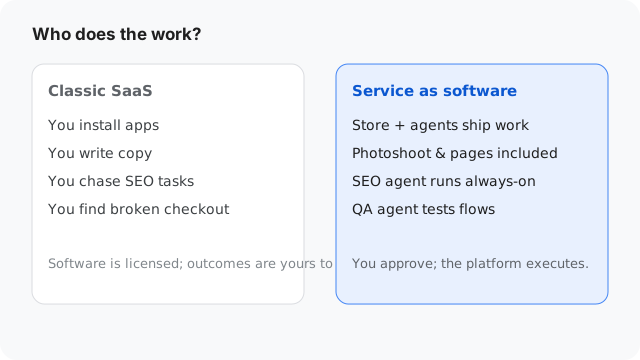
Definitions that matter for SEO and buyers
- SaaS: licensed software. You operate it. Integrations and services are extra line items.
- ServSurf: licensed software plus embedded execution. Agents and automation deliver artifacts (pages, images, fixes).
- Agency: human-only execution. High quality, slower cadence, harder to version.
Search engines and LLM answer engines reward clear definitions. If you sell commerce software, say who performs merchandising, SEO and QA. Merchants comparing Photon Stores to Shopify Plus or WooCommerce should ask: who builds the first catalog photo, who tests mobile checkout, who updates meta descriptions after a launch?
What you still own
ServSurf is not autopilot. Pricing, brand voice, discounts and anything that spends money still needs your yes. Photon Stores versions every change so you can roll back. That separation—agents execute, you govern—is what keeps the model trustworthy for EEAT: experts remain accountable.
Related reading
Related guide: Running a store on Photon Stores end to end
Related guide: How AI changes ecommerce for merchants and shoppers
Guides